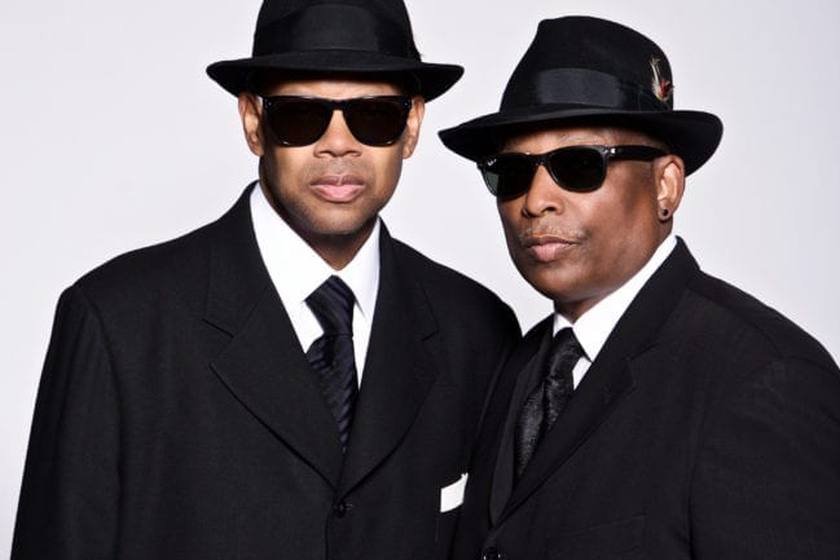
In the winter of 1983, Atlanta got the kind of storm the city almost never sees, and it left two young musicians from Minneapolis stranded. Jimmy Jam was 23. Terry Lewis was 26. They played keyboards and bass in the Time, the funk band Prince had assembled and produced, and the Time had a show that night in San Antonio. They were in an Atlanta studio finishing a record they were not supposed to be making, and they never made it to the stage.
What happened next has been retold online so often that it has hardened into a parable. Prince fires two sidemen, the sidemen go home with nothing but a song, and the song changes everything. The real story is better than the parable, and more useful, because it is not really about luck or weather. It is about two men who had been quietly building something of their own before anyone forced them to.
Two kids from Upward Bound
Terry Lewis was born in Omaha and raised in Minneapolis. James Harris III, son of the local blues and jazz musician Cornbread Harris, was born in Minneapolis in 1959. The two met in high school through a TRIO Upward Bound program on the University of Minnesota campus, according to their Songwriters Hall of Fame profile. It is worth pausing on that. Upward Bound is a federal college access program for students from low-income and first-generation families. One of the most consequential creative partnerships in American pop music began in a program built to widen the door for kids like them.
Lewis already had a band, Flyte Tyme, a fixture of the local scene. Jam played in other groups but kept turning up whenever Terry recorded. When Prince needed a band for a new act fronted by Morris Day, he took Flyte Tyme and restructured it as the Time in 1981.
It was a prestigious job with a ceiling built in. On the Time's debut album, the band members did not play at all; Day sang along to Prince's guide vocals note for note, as the band's history records. The Time gave the world “Jungle Love,” “The Bird” and “777-9311,” and it gave Jam and Lewis a front row seat to how hits get made and how a tour runs. What it did not give them was ownership of any of it.
The moonlighting problem
Jam and Lewis wanted to write and produce for other artists. That clashed with Prince's rules. They did it anyway.
In 1982 they were introduced to Clarence Avant, the music executive whose Tabu label was home to the S.O.S. Band. Their manager, Dina Andrews, set up a production company for the pair and began shopping them to her industry colleagues. They named it after Terry's old band. The Rock & Roll Hall of Fame dates Flyte Tyme Productions to 1982.
That date matters more than anything else in this story. In the viral version, the firing comes first and the company rises from the wreckage afterward. The record says otherwise. The company already existed. The client relationships were already forming. By the time the snow fell in Atlanta, Jam and Lewis were not musicians with a hobby. They were founders with a day job.
Snowed in
They had slipped away from the Time's run on Prince's 1999 tour to cut songs for the S.O.S. Band at Avant's request. Then the storm closed the airport, and the San Antonio show went on without them. Accounts of that night have Jerome Benton miming on bass while Prince played Lewis's part offstage, and Lisa Coleman filling in for Jam.
The reckoning came later, in Los Angeles. Prince asked them directly whether they had produced the S.O.S. Band. As Jam has told it, “He said, you are fired.” Jam walked out. Lewis stayed behind and tried to reason with him. The decision held.
History rarely hands us one clean version of a falling out between proud men, and accounts differ on whether a fine came before the firing. What nobody disputes is the outcome. Jam and Lewis were out of the Time, and they were free.
Free is the word Jam has used himself. He has said Prince freed them the very night they were mixing a song for the S.O.S. Band, and that the break was bound to happen sooner or later. The song was called “Just Be Good to Me.”
The song
“Just Be Good to Me” became a hit and established the duo's reputation. In short order Flyte Tyme was producing R&B hits for Gladys Knight, Patti Austin, Thelma Houston and Klymaxx, with Cherrelle, Cheryl Lynn and the Force M.D.'s on the roster too. The Rock Hall describes the sound they refined as the boom of the 808 drum machine, scorching synthesizer leads and deep melodic basslines. The duo had their own name for it: “the funky bottom and the pretty top.”
Notice what changed, and what did not. As members of the Time, they played someone else's parts on someone else's records under someone else's name. As Flyte Tyme, they owned the sound, set the terms and chose the clients. Same talent. Different position.
Home field
In 1985 they began working with Janet Jackson. She had two albums behind her and the most famous surname in pop music, but she had not yet arrived as an artist on her own terms. Jam and Lewis did not fold themselves into the Jackson family machinery in Los Angeles. They worked with her in Minneapolis, at their own studio.
Control arrived in 1986 and changed her career. “What Have You Done for Me Lately,” “Nasty,” “When I Think of You,” “Let's Wait Awhile” and the title track all came from that album, which the Songwriters Hall of Fame calls her breakthrough. It made Jackson a superstar in her own right and made her producers the most sought-after team in the business.
Then they did it again, on their turf and on their terms. Rhythm Nation 1814 was recorded entirely at Flyte Tyme in Minneapolis, with Jam and Lewis writing or co-writing almost every song. Jam has said they kept the label at a distance: “We didn't play it for the record company until it was totally done,” he told Number 1 Albums. The album sent seven singles into the top five of the Billboard Hot 100, four of them to No. 1. It remains the only album ever to do that.
Listen closely to “Escapade” and you can hear Janet shout out Minneapolis in the breakdown, a nod to the studio where it was made. Anywhere else that detail would be trivia. In this story it is the whole point. The biggest pop star in the world came to them.
Behind the glass
The roster kept growing: the Human League's “Human,” George Michael's “Monkey,” Boyz II Men's “On Bended Knee” and “4 Seasons of Loneliness,” Mariah Carey's “Thank God I Found You,” along with work for Mary J. Blige and New Edition. According to the Songwriters Hall of Fame, Jam and Lewis have written 41 Top 10 hits in the United States and hold more Billboard No. 1 hits than any other songwriting and production team in history. When they were inducted there in 2017, The Current put the tally at 16 No. 1s, across three consecutive decades.
Jam went on to chair the Recording Academy's board. In 2022 the Rock & Roll Hall of Fame inducted the pair for Musical Excellence. The person who inducted them was Janet Jackson.
What the side work was really building
The comfortable reading of this story is that a setback became a blessing, and that is true as far as it goes. Scripture says that time and chance happen to them all, and a freak snowstorm in Atlanta is about as pure an example of time and chance as history offers. But a storm cannot hand you a company. It can only reveal whether you already have one.
Jam and Lewis spent the months before that storm building equity in the one asset their day job did not own: their names as producers, attached to a business with their band's name on the door. When the job disappeared, the equity did not. The history of Black music in America is crowded with brilliant people who played on records they never owned. These two made sure the next chapter of their careers would be different, and they did it before anyone gave them permission or a reason.
There is a quiet discipline in that, the kind that rarely gets celebrated because it happens off the clock. Late sessions. A side company. A notebook of song title ideas, which is where the word “Escapade” came from. None of it looked like an empire at the time. It looked like two young men taking a risk their boss would not have approved.
The snowstorm stranded them. The firing freed them. But the work they were doing when nobody was supposed to be watching is what built everything that came after. Prince could take the band. He could not take the company, because it was never his.